
Top 10 Pipe Extrusion Machine Manufacturers for Buyers
Choosing a Pipe Extrusion Machine is a capital decision that shapes product quality, operating costs, and delivery reliability. Buyers should compare more than quoted output. A line rated for high throughput may struggle with a specific resin, wall thickness, or diameter range. Watch the details. Screw design, temperature control, die sizing, vacuum calibration, haul-off, and cutting accuracy all affect finished pipe. A steady melt and consistent dimensions matter on the factory floor.
Walter Michaeli, a respected plastics-processing scholar, offers a useful technical lens. The following is an editorial summary, not a verbatim quotation: “Reliable extrusion begins with a stable process, not a headline output figure.” Buyers can apply that principle by requesting material-specific trial data, measured tolerances, and a clear description of the test conditions. Ask how quickly operators can change tooling. Check whether screens, heaters, and wear parts are readily available. Small checks count.
This guide compares ten manufacturers through practical buyer criteria: machine range, customization, controls, commissioning, service support, and documented performance. It also considers whether suppliers can explain their recommendations in plain technical terms. A strong proposal should identify assumptions, not hide them. Compare like with like. The right choice depends on the pipe specification, planned production volume, available operators, and local service access. No ranking replaces a factory visit or a carefully reviewed acceptance test.
Understanding Pipe Extrusion Machines and Their Applications
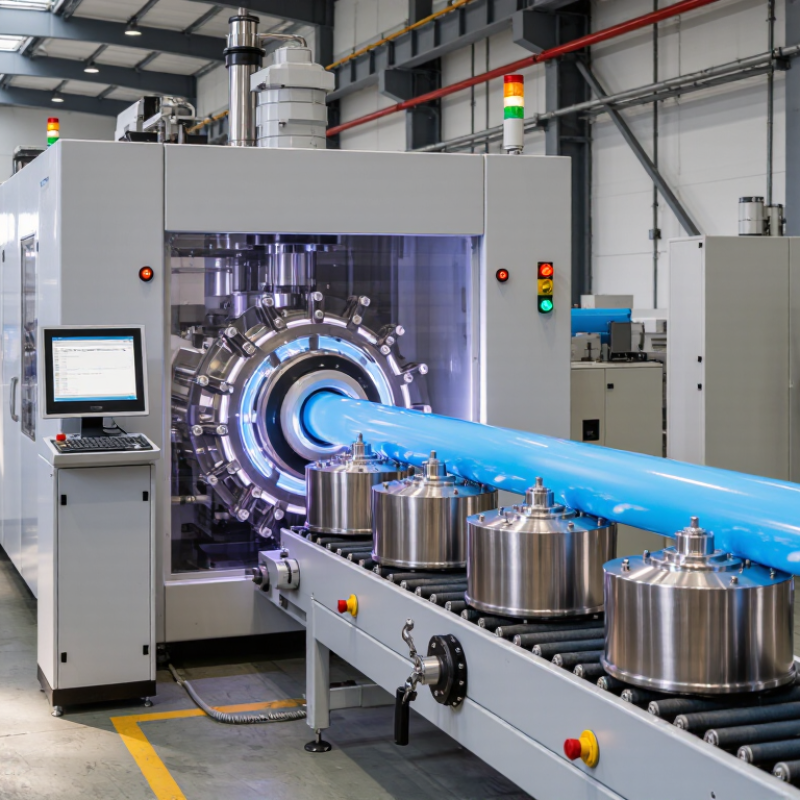
Pipe extrusion machines turn thermoplastic resin into continuous lengths of pipe. A feed hopper supplies pellets to a heated barrel, where a rotating screw melts and mixes them. The melt passes through an annular die, forming a hollow tube. A vacuum-sizing sleeve or calibration tank helps control the outside diameter, while cooling tanks stabilize the pipe. A haul-off pulls it forward at a set speed, and a cutter or coiler handles the finished product. Small changes matter.
These lines produce pipe for building drainage, irrigation, electrical conduit, and industrial fluid systems. The right setup depends on the resin, pipe diameter, wall thickness, and required output. Screw design, temperature zones, die dimensions, and cooling capacity all affect the result. Operators monitor melt pressure and wall thickness because a fast line can produce uneven pipe. A stable process still needs attention. Resin batches and room temperatures can shift, so settings may require adjustment. That can be frustrating. A machine’s advertised output alone does not reveal how consistently it can hold dimensions during a long production run.
Top 10 Pipe Extrusion Machine Manufacturers for Buyers - Understanding Pipe Extrusion Machines and Their Applications
Buyer-focused comparison of ten common pipe-extrusion line configurations. These are machine categories, not a ranked list of manufacturers.
| Machine / Line Type | Typical Materials | Common Extruder Setup | Indicative Pipe Outside Diameter | Typical Line Equipment | Common Applications | Key Buyer Considerations |
|---|---|---|---|---|---|---|
| Rigid PVC pipe extrusion line | PVC-U and, for suitable formulations, PVC-M | Usually a conical or parallel twin-screw extruder | Approximately 20–630 mm, depending on line configuration | Die head, vacuum sizing tank, cooling tanks, haul-off, cutter, and stacker | Building drainage, water distribution, conduit, and sewer systems | Check resin formulation compatibility, dimensional control, tooling range, and applicable pipe standards. |
| HDPE pressure-pipe extrusion line | HDPE and other polyethylene grades specified for pipe | Single-screw extruder; larger lines may use high-output screw designs | Approximately 20–1,600 mm; larger formats require specialized equipment | Pipe die, vacuum calibration, spray cooling, haul-off, cutter, and handling system | Water mains, gas distribution, irrigation, and industrial pipelines | Confirm the required diameter and pressure-class range, output at the target wall thickness, and cooling capacity. |
| PP-R hot- and cold-water pipe line | PP-R and PP-RCT compounds | Single-screw extruder, often with a multi-layer co-extrusion option | Commonly about 16–160 mm | Pipe die, sizing sleeve, vacuum and cooling tanks, haul-off, and cutter | Hot- and cold-water plumbing and building services | For reinforced or multi-layer products, verify layer control, material compatibility, and the specified product standard. |
| Corrugated double-wall pipe line | Typically HDPE or PP; some systems process PVC | One or more extruders feeding a corrugator and forming blocks | Commonly about 110–1,200 mm, depending on design | Co-extrusion die, corrugator, forming blocks, cooling system, cutter, and socketing equipment | Underground drainage, stormwater, cable protection, and non-pressure sewer applications | Compare forming-block availability, corrugation geometry, socket options, and achievable production speed. |
| Large-diameter polyethylene pipe line | HDPE and other suitable PE pipe grades | High-output single-screw extrusion system | Often from several hundred millimetres to over 1,600 mm on specialized lines | Large die head, long vacuum and cooling sections, heavy-duty haul-off, cutter, and pipe handling | Water transmission, outfalls, industrial process lines, and large drainage networks | Assess factory space, electrical demand, lifting and handling requirements, die changes, and maximum wall thickness. |
| Multi-layer barrier pipe line | PE or PP layers; may include an EVOH barrier layer or a reinforcement layer | Two or more extruders with a multi-layer die | Commonly about 16–110 mm, depending on product design | Co-extrusion die, layer-control system, calibration, cooling, haul-off, and cutter | Heating and plumbing systems requiring defined barrier or reinforcement properties | Verify layer structure, layer-thickness control, resin bonding requirements, and changeover procedures. |
| PEX or PE-RT pipe line | Crosslinkable polyethylene (PEX) or raised-temperature-resistant polyethylene (PE-RT) | Single-screw extrusion; PEX production may require a downstream crosslinking process | Commonly about 16–63 mm | Pipe die, calibration and cooling equipment, haul-off, cutter or coiler, and—where required—crosslinking equipment | Underfloor heating, radiator connections, and hot-water plumbing | Distinguish PEX process routes and verify the required crosslinking method, testing, and product certification. |
| PVC-O pipe production line | PVC-U feedstock processed through an orientation process | Extrusion system integrated with downstream pipe-orientation equipment | Common product sizes vary by process; specialized lines often cover roughly 110–630 mm | Extruder, sizing and cooling equipment, reheating section, orientation unit, and cutting system | Pressure-water distribution and other applications specified for oriented PVC pipe | Evaluate the complete orientation process, tooling range, process control, and required performance standards. |
| Microduct and small-bore tube line | HDPE, PE, or other specified thermoplastics | Compact single-screw extruder; multiple ducts may be produced in one line | Typically a few millimetres to around 20 mm per duct | Small die, vacuum or pressure sizing, cooling trough, haul-off, coiler, and optional bundling unit | Fibre-optic cable protection and telecommunications duct networks | Check bore consistency, wall-thickness control, coil capacity, and whether multi-duct bundling is required. |
| Drip-irrigation lateral line | Usually PE or other irrigation-grade polyolefin compounds | Single-screw pipe extruder with an in-line emitter insertion or integration system | Commonly about 12–20 mm for thin-wall lateral tubing | Extruder, sizing and cooling equipment, emitter feeder, haul-off, and high-capacity coiler | Low-pressure drip irrigation and agricultural water delivery | Assess emitter spacing and insertion accuracy, wall-thickness uniformity, line speed, and coiling requirements. |
Diameter ranges are indicative examples, not universal machine specifications. Actual capability depends on the die and tooling, material grade, pipe design, wall thickness, line layout, and applicable standards. Ask suppliers for verified output data at the required product dimensions.
FAQS
Pellets enter a heated barrel, where a rotating screw melts and mixes them. The melt passes through a ring-shaped die and forms a hollow tube. Cooling tanks help stabilize it.
A vacuum-sizing sleeve or calibration tank helps control the outside diameter. Cooling capacity and haul-off speed also affect the finished pipe. Small changes matter.
Consider resin type, pipe diameter, wall thickness, and hourly output. Screw design, temperature zones, die dimensions, and cooling capacity also influence results.
Melt pressure, room temperature, and resin batches can shift. Operators monitor wall thickness and adjust settings when needed. It can be frustrating.
Specify your resin, diameter range, wall thickness, and expected output. Also ask how the line handles startup, material changes, and dimensional adjustments.
Request a line layout and a clear equipment list. Check screw and barrel materials, die range, calibration method, haul-off control, and cutting accuracy.
Ask for production data using a similar resin and pipe size. A witnessed trial can help, but one successful run proves little about every shift.
Check local parts availability, technical response times, operator training, maintenance schedules, and installation support. Warranty terms matter. So does clear documentation.
Conclusion
This article introduces the role of a Pipe Extrusion Machine in producing pipes for applications such as water supply, drainage, and industrial systems. It explains how extrusion processes shape different materials and why machine design, output capacity, and production requirements matter. Readers will also find an overview of the main criteria for evaluating manufacturers, including equipment performance, material compatibility, manufacturing scale, technical support, and the ability to meet specific production goals.
The article compares the capabilities of ten leading manufacturers without focusing on any single brand, helping buyers understand how machines may differ in processing options, pipe dimensions, automation, and production volume. It also outlines practical considerations for selecting a supplier, such as budget, expected output, installation needs, maintenance, and long-term service. Together, these topics offer buyers a clear framework for comparing equipment and choosing a solution suited to their operation.
