
Top Automotive Tube Extrusion Line Manufacturers?
Choosing the right Automative Tube Extrusion Line manufacturer affects production stability, product quality, and long-term operating costs. Automotive tubes may serve cooling systems, fuel delivery, air conditioning, braking, or structural applications. Each use demands different material control, dimensional accuracy, and testing methods.
This guide examines leading manufacturers through practical purchasing criteria. We consider extrusion experience, engineering capability, line speed, temperature control, calibration systems, and after-sales support. A reliable supplier should explain its design choices clearly. It should also provide trial production data, energy information, maintenance guidance, and references from comparable factories. Details matter. A clean control cabinet, stable melt pressure, and consistent tube thickness can reveal more than polished marketing language.
Real production experience also requires careful questions. Can the line process the required polymer or multilayer structure? How quickly can operators change tooling? Are spare parts available in the buyer’s region? Does the manufacturer support installation and operator training? These points often determine whether a line performs well after delivery. No ranking is perfect. Factory conditions, budgets, and product standards differ widely. Some promising suppliers may have limited public information, while established brands may not fit every application. Therefore, this overview encourages verification through technical documents, factory audits, sample testing, and direct customer feedback. It aims to support an informed decision, not promote a single company. Manufacturing rarely follows a brochure exactly. Careful evaluation remains essential.
What Is an Automotive Tube Extrusion Line?
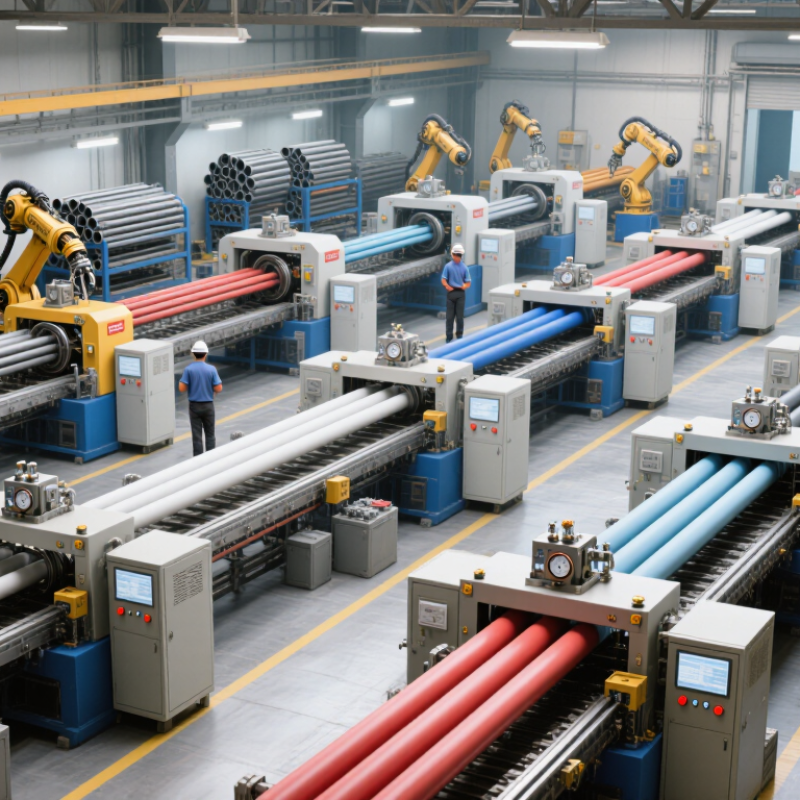
An automotive tube extrusion line is a production system that forms plastic or metal-compatible polymer tubes continuously. It transforms raw pellets into precise profiles for coolant lines, air ducts, fuel-system components, and protective sleeves. The process usually includes feeding, melting, extrusion, sizing, cooling, cutting, and inspection.
A stable line begins with controlled material feeding. Heaters melt the polymer inside a screw barrel, while the die shapes its profile. Vacuum sizing can hold diameter accuracy as the hot tube passes through a cooling tank. Pullers maintain steady tension, and a cutter produces repeatable lengths. Sensors monitor temperature, pressure, speed, and wall thickness. Small changes matter. A minor temperature drift may create oval tubes or uneven walls.
From practical production experience, line selection depends on more than output speed. Engineers should examine resin behavior, tube diameter, layer structure, tolerance targets, and required testing. Multilayer lines may add barrier or reinforcement functions, but they also increase setup complexity. Cleaning the die takes time. That detail is often underestimated.
Reliable manufacturers should provide documented trials, measurable tolerance data, operator training, and accessible maintenance guidance. A useful factory test checks dimensions, surface quality, pressure resistance, and long-run stability. Still, no line removes every production risk. Material batches can vary, and cooling conditions may need adjustment. Careful records help teams find the real cause instead of blaming the machine.
Top Automotive Tube Extrusion Line Manufacturers? - What Is an Automotive Tube Extrusion Line?
| Evaluation Dimension | Typical Technical Data | Function in an Automotive Tube Extrusion Line |
|---|---|---|
| Definition | A continuous manufacturing system that melts polymer or processes metal and forms it into a tube with a controlled cross-section. | Produces lightweight tubes for fluid transfer, air management, fuel systems, thermal management, and structural applications. |
| Common Tube Materials | Polyamide, polyethylene, polypropylene, thermoplastic elastomers, fluoropolymers, aluminum, and steel, depending on the process design. | Material selection determines temperature resistance, chemical compatibility, flexibility, pressure capability, and tooling requirements. |
| Tube Outside Diameter | Polymer tube lines commonly cover approximately 2–100 mm; specialized systems may handle larger diameters. | The die, sizing sleeve, vacuum tank, haul-off, and cutting equipment must be matched to the required diameter range. |
| Wall Thickness | Typical automotive polymer tubing may use wall thicknesses from about 0.5–5 mm, depending on pressure, flexibility, and application. | Stable melt flow, accurate tooling, centered mandrels, and closed-loop control help maintain uniform wall thickness. |
| Extruder Configuration | Single-screw extruders are widely used for standard thermoplastics; twin-screw or co-extrusion systems are selected for compounding or multilayer tubes. | The screw design, length-to-diameter ratio, and feeding system influence melting quality, output stability, and material residence time. |
| Operating Temperature | Thermoplastic processing zones are commonly controlled within approximately 160–350°C, depending on the polymer grade. | Independent heating and cooling zones help prevent material degradation and maintain consistent melt viscosity. |
| Sizing and Cooling | Vacuum calibration tanks, water cooling tanks, air cooling, or combinations of these methods are commonly used. | These systems fix the tube dimensions, improve surface quality, and reduce deformation during solidification. |
| Line Speed | Approximately 5–150 m/min is common for polymer tube extrusion, with actual speed depending on diameter, wall thickness, material, and cooling capacity. | Higher speed improves productivity only when dimensional stability, cooling capacity, and downstream handling remain adequate. |
| Dimensional Control | Laser or optical gauges may measure outside diameter, ovality, and wall thickness continuously; achievable tolerances depend on material and line design. | In-line measurement reduces scrap and supports automotive quality documentation and process traceability. |
| Downstream Equipment | Typical components include a haul-off, caterpillar or belt puller, cutter, coiler, printer, accumulator, and automatic length counter. | Downstream equipment determines product length, packaging format, line synchronization, and production flexibility. |
| Multilayer Capability | Co-extrusion can produce two-layer, three-layer, or more complex tube structures when barrier, bonding, reinforcement, or flexibility requirements exist. | Multilayer construction can combine different material properties within one tube while reducing assembly steps. |
| Quality and Compliance Features | Recipe management, alarm records, data logging, automatic fault detection, and traceability functions are commonly specified for automotive production. | These features support repeatable manufacturing, process audits, preventive maintenance, and customer quality requirements. |
| Manufacturer Selection Criteria | Evaluate material expertise, tested output data, tooling capability, control-system integration, service coverage, spare-parts availability, and commissioning support. | A suitable line should be selected from verified application data rather than rated speed alone. |
Note: Technical ranges are typical reference values for automotive polymer tube extrusion and vary according to material grade, tube geometry, tooling, cooling conditions, and required product tolerances.
FAQS
Compare complete production results, not isolated machine features. Review output stability, dimensions, surface quality, energy use, and operator workload.
Ask about PA, TPU, PVC, and multilayer automotive tubes. Request samples made with your actual resin and tube dimensions.
The supplier should explain die design, melt control, cooling, haul-off accuracy, and cutting performance. Vague answers are warning signs.
Request production records, dimensional data, and factory acceptance testing. Measure outer diameter, wall thickness, speed, ovality, and scrap rate.
If possible, watch a similar line running. Listen for unstable movement, unusual vibration, and inconsistent tube handling.
Check commissioning, process training, preventive maintenance, troubleshooting, and remote-service response times. Support after installation matters.
Turnkey builders provide complete lines. Modular specialists offer flexibility. Custom integrators suit unusual diameters, tight bends, or embedded reinforcement.
Maximum speed can hide poor performance. A line may reach 120 meters per minute but lose hours during changeovers.
Lightweight thermal-management tubes need stable ovality, wall thickness, and surface quality. Cooling efficiency and online gauging also matter.
No. A brochure is not production evidence. Speak with current users and verify similar operating conditions; my evaluation could still miss something.
Conclusion
An Automative Tube Extrusion Line is an integrated production system designed to manufacture precise, durable tubes for automotive applications. It typically combines material feeding, heating, melting, forming, sizing, cooling, pulling, cutting, and quality inspection processes. Its core components must work together smoothly to maintain consistent dimensions, surface quality, mechanical strength, and production efficiency. Depending on the application, the line may process different engineering plastics or specialized materials to produce fuel, air, coolant, electrical protection, or structural tubing.
When evaluating manufacturers, buyers should consider extrusion stability, temperature control, dimensional accuracy, energy efficiency, automation capabilities, maintenance requirements, customization options, and technical support. Key performance standards include reliable output, low material waste, repeatable tolerances, and compliance with automotive quality expectations. Different manufacturer types may focus on standard production lines, highly customized systems, high-speed solutions, or flexible equipment for multiple tube specifications. Selecting the right partner requires matching the line’s capabilities with product design, production volume, material characteristics, and long-term operational goals.
