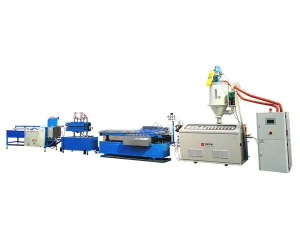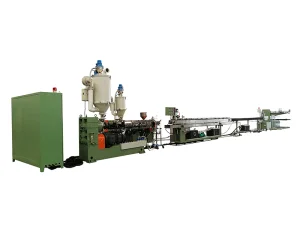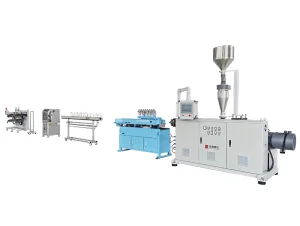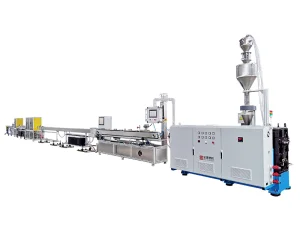
High-Precision PVC Extrusion & Downstream Processing Machinery
Engineered for tight dimensional tolerance control, low melt thermal stress, and continuous zero-drift production line stability.
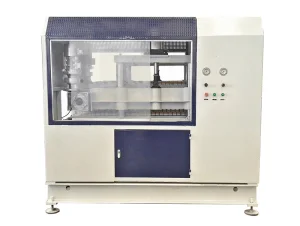
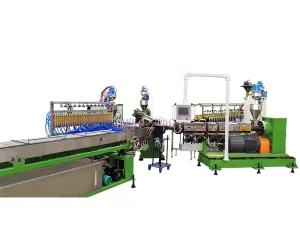
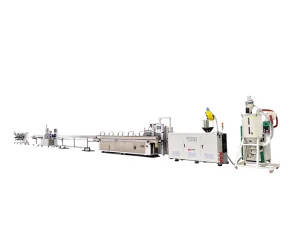
Understanding PVC Rheology, Gelation, and Thermal Degradation Parameters
Polyvinyl Chloride (PVC) is unique among major thermoplastic polymers due to its polar chlorine molecule structure, high melt viscosity, and strict thermal processing window.
K-Value Selection & Viscosity Impact
The molecular weight of PVC compounds is measured via K-Value (Fikentscher K-value). Selecting the correct resin grade directly dictates extrusion torque, shear heat development, and mechanical strength:
- K-57 to K-58: Low molecular weight, ideal for complex, thin-walled rigid PVC profiles requiring rapid flow and minimal pressure drops.
- K-65 to K-68: Standard industrial benchmark for rigid PVC pipes, window profiles, and automotive sealing channels balancing impact strength with extrudability.
- K-70 to K-75: High molecular weight, reserved for flexible PVC medical tubing, high-flexibility seals, and cable jacketing where elasticity and tensile tear resistance are critical.
Melt Gelation & Fusion Mechanics
Unlike polyolefins (PP/PE) that exhibit a sharp melting point, PVC transitions from solid primary grains (100–150 μm) to sub-microscopic domains (1 μm) through thermo-mechanical work inside the extruder barrel.
Achieving optimal gelation degree (typically 65% to 85% for rigid applications, and 85–95% for pressure pipes) is essential. Under-gelation causes premature brittle cracking; over-gelation destroys thermal stabilizers, releasing corrosive Hydrochloric Acid (HCl) gas.
Stabilization Chemistry Evolution
Modern global regulations (REACH, RoHS 3.0) have mandated a complete transition away from traditional Lead-based stabilizers. Today's manufacturing landscape relies on advanced non-toxic eco-stabilizers:
- Calcium-Zinc (Ca/Zn) Systems: Excellent initial color retention, requiring precise barrel temperature zone optimization to prevent plate-out.
- Organotin Stabilizers (Methyl/Octyl Tin): Highest clarity and performance for medical-grade plasticized s-PVC tubing and transparent profiles.
Global PVC Extrusion Market Landscape & China Manufacturing Dominance
Analyzing global supply chain shifts, regulatory forces, energy dynamics, and why Chinese OEM machinery manufacturers are taking center stage in precision plastic processing.
The Evolution of High-Speed & Eco-Friendly PVC Processing
The worldwide market for extruded PVC profiles, tubes, micro-ducts, and sealing strips continues to expand rapidly, driven by urbanization in emerging markets, modern lightweighting in EV automotive manufacturing, and stringent energy-efficiency standards in residential construction.
Historically dominated by European machinery producers, the extrusion sector has experienced a dramatic technological parity shift over the past decade. Chinese manufacturers—led by technology pioneers like Jiangsu Baodie Automation Equipment Co., Ltd. (BAOD EXTRUSION)—have integrated European-level precision screw engineering with advanced Taiwanese control philosophies and localized cost advantages.
Key industry macro-trends impacting global processors include:
- Carbon Neutrality & PCR Integration: Incorporation of up to 40-70% Post-Consumer Recycled (PCR) PVC into non-critical inner cores of co-extruded profiles and conduits without compromising mechanical integrity.
- Micro-Extrusion Precision: Transition from standard pipe production to micro-bore medical tubing (0.5 mm ID) and multi-lumen catheter lines operating under cleanroom conditions.
- Automated Closed-Loop Manufacturing: Adoption of ultrasonic wall-thickness monitors, double-axis laser diameter gauges, and servo closed-loop feedback systems connected to melt pumps.
Global PVC Extrusion Market Drivers (2025–2032)
Standardized Parameter Mapping Across Extrusion Sub-Systems
A systematic operational roadmap detailing the four key processing stages in modern plastic extrusion lines, from raw resin metering to automatic coiling.
Extruder Screw & Barrel Temperature Profile Vectoring
PVC extruders utilize specialized screw geometries (Single Screw with L/D 25:1 to 30:1 for flexible s-PVC, or Conical/Parallel Twin Screws for rigid u-PVC powder). Precise temperature zone management prevents shear heating runaway:
Melt Homogenization & Pressure Equalization
Using high-precision gear melt pumps downstream of the extruder eliminates pressure pulsation (surging). This maintains a constant melt flow rate into the spider die or coat-hanger profile die, ensuring stable wall thickness distribution.
Vacuum Calibration & Controlled Crystallization Cooling
Hot extrudates enter stainless-steel vacuum sizing tanks equipped with internal water-ring vacuum pumps and multi-stage temperature-controlled water sprays. Vacuum level (-0.02 to -0.07 MPa) locks in exact outer dimensions without collapsing hollow internal chambers.
Synchronized Servo Haul-Off & Precision Cutting/Winding
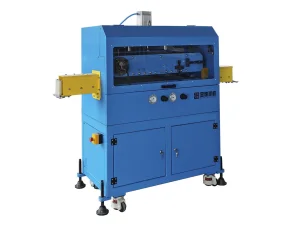
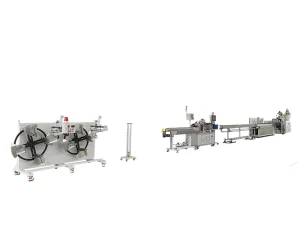
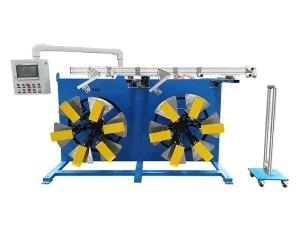
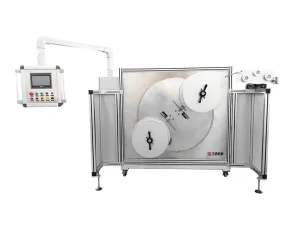
Downstream crawler or belt pullers driven by digital servo motors operate in sync with the extruder speed. Automated fly-knife cutters or precision dual-spool traverse coilers (e.g., BAOD SPS-Dh series) yield clean, burr-free end cuts or perfectly wound reels.
Comprehensive PVC Extrusion Defect Matrix & Solution Protocols
A reference guide for plant managers and process engineers to rapidly diagnose, isolate, and eliminate common extrusion quality issues.
| Defect Manifestation | Primary Root Cause | Impact Severity | Engineering Corrective Action |
|---|---|---|---|
| Melt Fracture / Sharkskin Surface | Critical wall shear stress exceeded at die exit; melt temperature too low. | High / Scrap | Increase die zone temperature by 5–10°C; polish die land surfaces; check internal lubricant (PE wax / Stearic acid) ratio. |
| Thermal Discoloration / Yellowing | Excessive residence time in barrel dead spots; stabilizer exhaustion; shear overheating. | Critical | Inspect screw/die for dead zones; increase stabilizer dosage; reduce screw RPM; check barrel cooling fans. |
| Wall Thickness Pulsation (Surging) | Inconsistent solid feed conveying; uneven temperature in melt zone; screw slip. | Medium | Optimize feed pocket cooling water temp (keep < 50°C); install melt gear pump; check hopper bridging. |
| Internal Voids / Bubbles | High moisture level in PVC compound/fillers; volatiles in plasticizer package. | Medium | Pre-dry raw materials (80°C for 2 hrs); increase barrel vacuum degassing port vacuum to -0.08 MPa. |
| Profile Warpage & Bent Ends | Uneven internal stresses; asymmetric cooling water distribution in sizing tank. | Quality Standard | Re-align calibration die with haul-off center axis; adjust water spray nozzles for uniform 360° cooling. |
| Plate-Out on Die Land & Sizing Tank | Migration of incompatible additives (fillers, pigments, low-cost lubricants). | Maintenance | Clean die land with brass scraper; optimize additive compatibility package; use surface-treated CaCO3 filler. |
Tailored Processing Solutions for Specific Market Sectors
Exploring specialized extrusion line configurations engineered for automotive, medical, electrical, and industrial applications.
Automotive Sealing Strips & Glass Runs
Modern passenger cars and EVs require multi-durometer co-extruded sealing profiles (combining rigid PVC/TPV bases with soft sponge sealing lips and metal insert carriers).
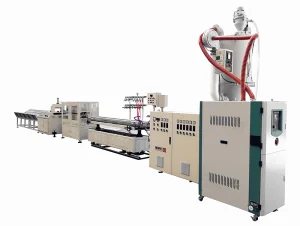
BAOD Solution: Multi-extruder co-extrusion lines equipped with continuous metal strip payoff, inductive pre-heating, precision cross-head dies, and online flocking/coating modules.
Medical Cleanroom PVC Micro-Tubing
Medical-grade soft PVC tubing used for IV infusion sets, blood transfusion lines, and dialysis circuits requires non-DEHP plasticizer formulations and strict particulate control.
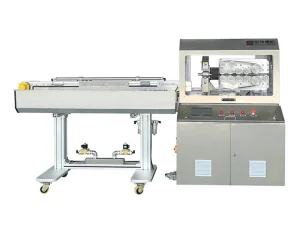
BAOD Solution: Compact micro-extrusion lines with stainless steel cleanroom-compliant enclosures, servo-controlled melt pumps, online dual-plane laser sizing, and high-speed rotary cutters.
Single-Wall Corrugated Wire Harness Conduits
Used extensively in automotive electrical wiring harnesses and industrial machinery protection. High-speed forming requires rapid block turnover and precise wall distribution.
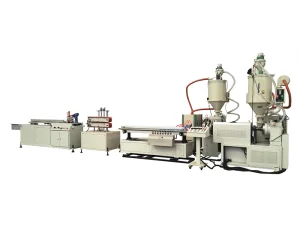
BAOD Solution: High-speed corrugated pipe extrusion lines with continuous vacuum-assisted mold block corrugators (up to 30 m/min output) compatible with PA, PE, PP, and PVC materials.
The Future of Plastic Extrusion: Smart Automation & Circular Economy
How cutting-edge digital control and sustainable compounding are reshaping processing standards for international manufacturers.
1. Industry 4.0 Closed-Loop System
Integration of OPC-UA industrial protocols across the entire line. Data from ultrasonic wall thickness sensors automatically communicates with extruder motor drives and haul-off speeds, making micro-adjustments in real time to eliminate dimensional drift without human intervention.
2. Multi-Layer Co-Extrusion Tech
Co-extrusion technology enables processors to concentrate virgin polymer and colorants on outer surface layers while incorporating up to 70% recycled post-industrial scrap or bio-based PVC compounds in the core layer, reducing raw material costs significantly.
3. Energy-Efficient Direct Motors
Replacing traditional AC induction motors and gearboxes with high-torque permanent magnet direct-drive motors reduces overall electrical power consumption by 15-25% while eliminating gearbox vibration and maintenance downtime.
Frequently Asked Questions (FAQ) on PVC Processing & Machinery
In-depth technical answers addressing operational, metallurgical, formulation, and procurement questions for production professionals.
What is the key difference between single-screw and twin-screw extruders for PVC processing?
Single-screw extruders rely on friction between resin pellets and the barrel wall to generate conveying pressure, making them suitable for pre-pelletized plasticized soft PVC (s-PVC). Twin-screw extruders (conical or parallel) offer positive displacement conveying and superior mixing without generating excessive shear heat. They process raw dry-blend PVC powder directly, eliminating double-heating costs.
How do you prevent Hydrochloric Acid (HCl) corrosion inside the barrel and die?
When PVC experiences thermal degradation, it releases HCl gas, which corrodes standard carbon steels. BAOD EXTRUSION uses bimetallic barrels lined with nickel-based alloys (e.g., Inconel or tungsten carbide coatings) and chrome-plated, high-grade die steels (such as 3Cr17 / 1.2316 stainless steel) to resist chemical attack and extend equipment service life.
Why is precise temperature control critical in the extruder feed throat zone?
If the feed throat temperature exceeds 50°C–60°C, PVC powder or soft pellets begin to soften prematurely and adhere to the screw root, causing "hopper bridging" and output fluctuation. BAOD extruders feature dedicated water-jacketed feed zones with independent temperature regulation to maintain smooth solid conveying.
What parameters are required to configure a custom profile or tube extrusion proposal?
To receive an accurate engineering proposal from BAOD EXTRUSION, please provide: 1) Detailed CAD/PDF 2D cross-sectional drawings with dimensional tolerances; 2) Polymer resin specification datasheet (K-value, filler content, hardness Shore A/D); 3) Target line speed (m/min) or output capacity (kg/h); 4) Downstream cutting/coiling preferences; and 5) Local electrical power standards (e.g., 380V 50Hz / 480V 60Hz).
How does closed-loop laser measurement improve dimensional quality?
Online dual-axis laser diameter gauges continuously measure the extrudate's outer diameter (OD) immediately after the vacuum sizing tank. If the OD drifts from nominal value due to thermal expansion or batch material variance, the gauge sends an analog signal to the haul-off puller, automatically adjusting haul-off speed up or down to keep dimensions within tight tolerances.
Advanced Profile, Tube & Multi-Layer Extrusion Solutions
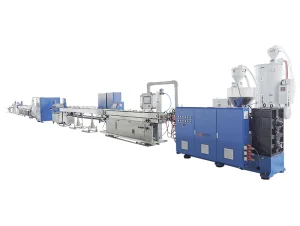
Complete turn-key production lines and auxiliary extrusion modules engineered by Jiangsu Baodie Automation Equipment Co., Ltd.