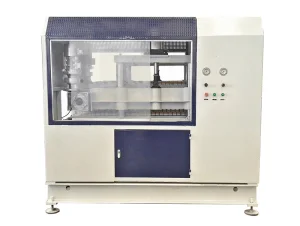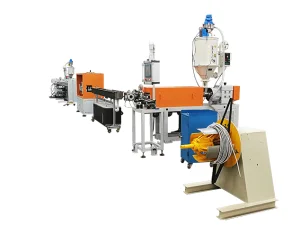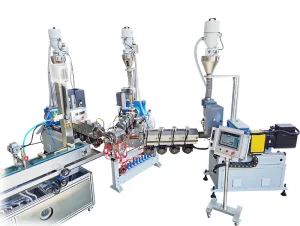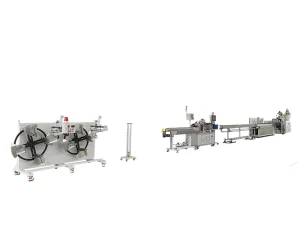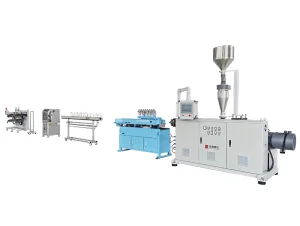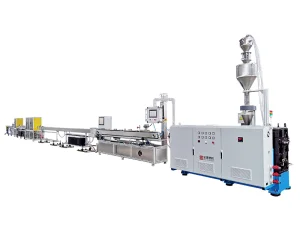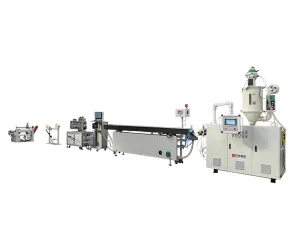
Featured Production Lines & Extrusion Downstream Systems
Engineered by BAOD EXTRUSION (Jiangsu Baodie Automation) to eliminate downstream dimensional instability through integrated closed-loop automation.
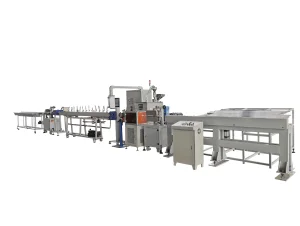
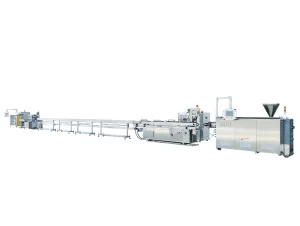
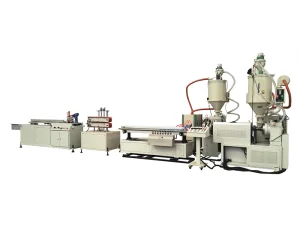
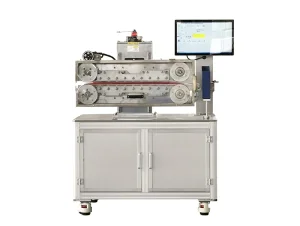
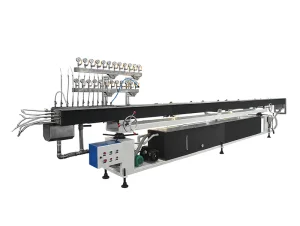
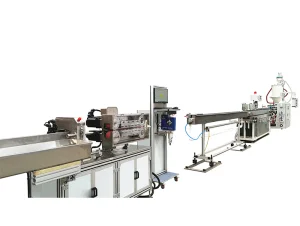
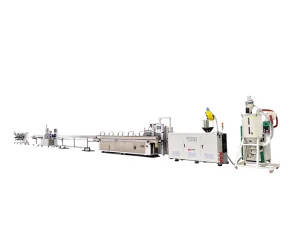
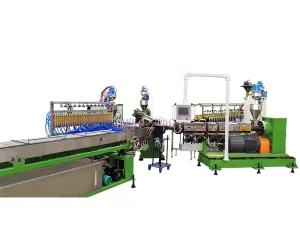
Systematic Troubleshooting Matrix for Precision Extrusion Plants
Uncontrolled variations in rheology, thermal equilibrium, or mechanical downstream sync translate directly into rejected production batches. Use this empirical diagnostic matrix to trace and solve root defects.
| Defect Mode | Root Mechanism (Thermodynamic / Mechanical) | Primary Sensor Signatures | Standard Mitigation Protocol | Severity |
|---|---|---|---|---|
| Melt Fracture (Sharkskin / Gross) | Critical shear stress exceeds boundary velocity limits at the die exit land, causing cyclical elastic rupture in the outer polymer skin layer. | Die pressure transducer spikes; irregular high-frequency surface wave profiles under laser profilometry. | Increase die land temperature by 5–12°C; polish exit lands to Ra < 0.05 μm; introduce fluoropolymer processing aids (PPA) to elevate slip velocity. | Critical Defect |
| Wall Thickness Eccentricity | Circumferential temperature differential along the tooling mandrel, misaligned die centering bolts, or uneven quench spray cooling profiles. | Multi-axis ultrasonic wall monitor displays azimuthal thickness phase offsets (> 0.04 mm variation). | Recalibrate tool heater bands using thermal imaging; equalize vacuum sizing tank spray nozzle pressures; true die gap mechanically with dial gauges. | High Tolerance Drift |
| Parison / Extrudate Surging | Unstable solids conveying in the feed zone or premature compression melting resulting in variable melt pump inlet pressure. | Amperage oscillation on main drive motor (> 8% swing); cyclic barometric pressure fluctuations in vacuum vent port. | Optimize feed throat cooling temperature (keep water jacket at 45–60°C); adjust barrel Zone 1–2 temperature curve; verify pellet bulk density. | Throughput Drag |
| Gels, Specks & Degradation | Prolonged polymer residence time within dead zones of the breaker plate, screw stagnation pockets, or excessive thermal shear decomposition. | Optical vision systems report dark inclusions; localized polymer discoloration in clear tubing batches. | Implement purge routine with high-viscosity cleansing resin; disassemble and streamline flow adaptors; inspect chrome-plated screw barrier flights. | Purity Rejection |
| Internal Micro-Voids & Bubbles | Moisture adsorption within hygroscopic polymers (e.g., PA11/12, TPU, PC) or trapped volatiles escaping under atmospheric pressure. | Sub-surface circular acoustic reflection in ultrasonic scans; cross-section microscopy reveals unclosed cavities. | Bake resin to dew point < -40°C in desiccant hopper dryers; ensure barrel vacuum degassing section pulls > -0.09 MPa vacuum. | Structural Failure |
Procurement Imperatives for International Industrial Buyers
Why tier-1 Tier-2 suppliers across North America, Europe, and Asia-Pacific are rethinking their capital expenditure strategies toward proven Chinese precision extrusion OEMs.
Total Cost of Ownership (TCO) Realignment
Traditional procurement protocols historically prioritized legacy Western European extrusion builders. However, escalating capital overheads and prolonged lead times (often 12–16 months) have shifted market demand toward Chinese elite machinery builders that leverage Taiwanese engineering tolerances with rapid delivery cycles.
Multi-Layer Lightweight Automotive Transition
With electric vehicles (EVs) mandating lower permeation and complex thermal-management fluid circuits, processors require co-extrusion systems handling 3-layer to 5-layer PA/EVOH structures. Chinese facilities engineering lines with multi-pump synchronization minimize the capital entry barrier for Tier-1 automotive programs.
Cleanroom Medical Tube Scalability
Disposable medical line suppliers face strict audits under ISO 13485. Procurement teams look for lines capable of maintaining ±0.01 mm dimensional envelope at speeds exceeding 150 m/min, with stainless-steel mirror-finished contact points and HEPA-filtered enclosed water calibration systems.
Technological Horizons: Smart Extrusion & Circular Polymers
Where sensor telemetry, closed-loop algorithmic correction, and recycled polymer compounding intersect to define extrusion manufacturing through 2030.
Edge-AI Melt Rheology Feedback
Traditional lines rely on delayed downstream inspection. The emerging benchmark integrates real-time pressure transducers and melt viscosity monitoring directly at the transition zones, utilizing PLC neural networks to adapt screw RPM and heater band duty cycles instantaneously before dimensional drift occurs.
Processing High-Ratio Recycled Resins (PCR)
With ESG legislation requiring 30%+ post-consumer resin content in industrial pipes and profiles, future extrusion lines demand specialized barrier screw geometries with intensified dispersive mixing elements that homogenize variable Melt Flow Index (MFI) resins without thermal shearing.
All-Electric Servo Driven Downstream Units
Replacing hydraulic pulling and clamping mechanisms with direct-drive multi-axis synchronous servo motors eliminates hydraulic fluid contamination risks in cleanrooms, boosts tracking accuracy to < 0.05% error, and slashes line energy consumption by 22–30%.
Engineering Audits, Certification & Global Lifecycle Continuity
Reliability in precision plastics extrusion extends far beyond hardware assembly—it encompasses rigorous regulatory alignment, international power adaptation, and factory floor validation.
CE & UL Regulatory Harmonization
All BAOD line units are manufactured with dual electrical schematics compatible with European 400V 50Hz and North American 480V 60Hz systems. Panels feature integrated safety interlocks, emergency stop loops, and CE Machinery Directive compliance.
For specialized cleanroom and automotive deployments, component tracing ensures all contact alloys satisfy stainless 304/316 surface finish criteria, while electronic components are standardized around global brands including Siemens, Schneider, and Omron to guarantee readily available replacements worldwide.
Factory Acceptance Test (FAT) Protocol
Before dispatch from our 16,000 m² Haian facility, production lines undergo continuous trials using the customer's proprietary resins. Real-time laser gauging data and scrap yield metrics are captured and bound into the qualification portfolio.
Through our dedicated Global Service infrastructure, on-site commissioning engineers support your initial start-up, configure custom recipe memory on the human-machine interface (HMI), and train local maintenance teams in root-cause troubleshooting routines.
Expert Answers: Engineering, Troubleshooting & Plant Operations
Direct technical insights to guide production directors, tooling supervisors, and procurement managers in line optimization.
What are the earliest mechanical indicators of screw and barrel wear before tube wall failure occurs?
How does BAOD EXTRUSION prevent ovality problems in thin-walled, small-diameter tubing lines?
What parameters must be harmonized when co-extruding incompatible polymers in fuel lines?
Why is dew-point control often more critical than hopper temperature for engineering thermoplastics?
How can a factory determine whether dimensional drift stems from the extruder or downstream hauling?
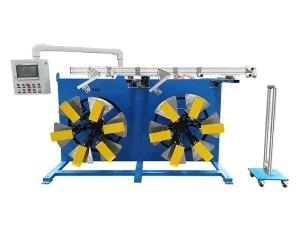
Industrial Profile, Pipe & Coil Extrusion Machinery
Explore advanced pullers, corrugated pipe line formers, and high-speed automatic winding coilers built for turnkey reliability.